Choosing a multi-diver hookah system means matching a complete manufacturer-approved configuration to the people who will use it. Diver count, operating depth and the equipment supplied for each person belong in the same decision. A headline such as “four divers” does not mean four people can use every depth or accessory combination offered for that model.
This buying guide explains what to verify with Brownie’s before ordering a system or adding diver equipment. It is a selection checklist, not instructions for assembling, modifying or diving a surface-supplied air system. Appropriate training and the current instructions for the exact equipment remain essential.
Start with the complete configuration
A hookah system supplies breathing air from equipment at the surface to divers through hoses and regulators. For a group, the buying question is not simply how many hoses can be connected. Ask which combination of compressor, air-delivery equipment, power source and diver equipment the manufacturer approves for the intended use.
Bring Brownie’s a description of the planned crew and outing. Record the maximum number of people who will be using the air supply together, the setting, the intended task and whether portability or permanent boat installation matters. Those details make the conversation more useful than starting with an accessory shopping list.
Read diver count and maximum depth together
Brownie’s generally recommends staying at 30 feet or less. The ratings below are maximum equipment capabilities for the stated configuration, not target dive depths or a promise that every group can reach them. Some people breathe more heavily than others. Higher breathing demand, exertion and conditions can reduce the depth and number of divers a system can support. Follow the lower limits imposed by the actual equipment configuration, conditions, training and individual divers.
Choose a system with the crew’s breathing demand in mind. Adding a diver changes the load on the shared air supply, so the same maximum depth does not apply to every crew size.
The OG: gas-system capacity and depth ratings
The OG is Brownie’s Original Gas system. Select the engine and compressor configuration that fits your crew: Single Head Briggs & Stratton, Single Head Honda, or Dual Head Honda.
*Configuration matters: The 65-foot ratings require the appropriate Brownie’s-approved deeper-water hose and equipment package. Do not assume the standard package has the same capability. Confirm the exact current configuration with Brownie’s before purchase or use. Adding a Safety Bundle does not change the compressor’s depth or diver-capacity rating.
For a four-person crew or heavier breathing demand, Brownie’s recommends the Dual Head Honda OG for its greater airflow capacity. Maximum ratings still depend on the actual divers and conditions; Brownie’s general recommendation remains 30 feet or less.
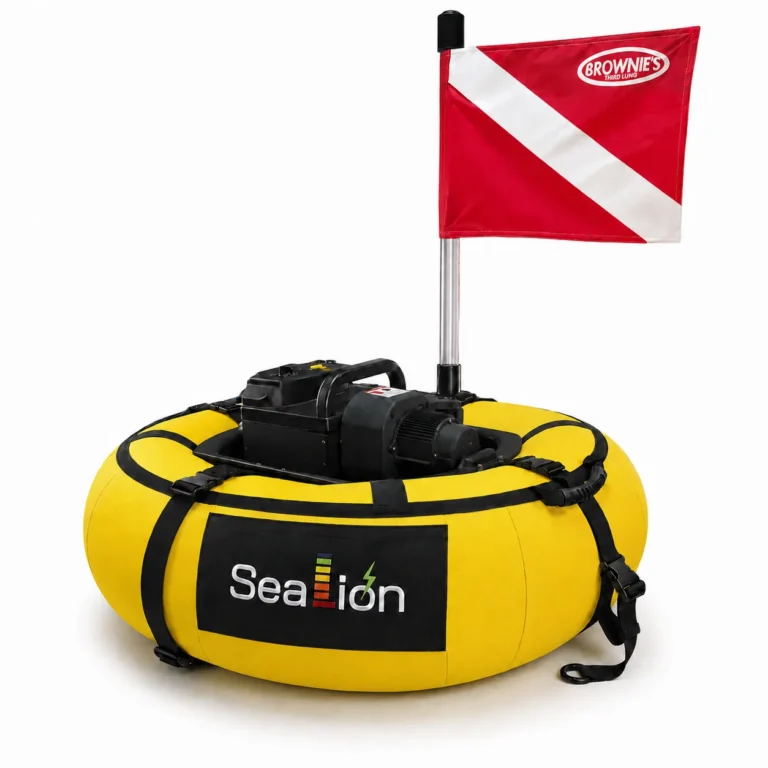
Sea LiON: maximum depth by diver count
The Sea LiON battery-powered system has the following maximum capabilities when appropriately configured:
These are maximums, not guaranteed capabilities for every group. Heavier breathing can reduce the system’s maximum capability, as can exertion and conditions. Brownie’s generally recommends staying at 30 feet or less; the lower 15-foot maximum applies with four Sea LiON divers. A two-diver 65-foot rating must not be applied to a three- or four-diver group.
Keep depth and battery planning separate. A charged battery does not guarantee a particular dive duration or make a maximum-depth configuration suitable for every diver. Follow the current instructions for the actual equipment and plan within the group’s limits.
An Add-A-Diver kit is part of a configuration
Review the official Add-A-Diver kit and hoses and kits with the model identification for your system at hand. Ask whether the kit is compatible, what it includes and which limits apply after the change.
An extra set of breathing equipment does not independently increase the compressor’s approved capacity. A connector fitting an outlet is not evidence that the complete arrangement is approved. Get the configuration confirmed before ordering, particularly when extending an older or previously owned system.
This is also the time to identify mixed components or missing documentation. Give support the actual model and component information, rather than asking whether an unspecified “Brownie’s hose” will work.
Check what each diver position includes
Compare quotations by complete diver positions. Record the components supplied for each person, which items are optional and whether the selected package matches the quotation. Ask Brownie’s to resolve differences between a photograph, product description and the option selected at checkout.
For Sea LiON, the current listing describes individual diver equipment and basic tow belts. Add the matching Safety Bundle to equip the crew with Spare Air and dive computers. Check the selected quantities so every diver has their own equipment.
Include Spare Air, dive computers and free training
Brownie’s always recommends Spare Air and a dive computer for each diver, especially when diving deeper than 30 feet. These are now available together as the Safety Bundle. Select the matching bundle for the number of divers when configuring The OG or Sea LiON.
Spare Air provides an independent emergency breathing source, and a dive computer provides dive information for the individual diver. Neither item increases the system’s operating limits or replaces training, proper dive planning, maintenance or emergency preparation.
Brownie’s offers a free online training course available to everyone. Take the course and follow the current product instructions before using a surface-supplied air system. The course is a resource for all divers, not only customers buying a new system.
Power choice does not replace capacity verification
Gasoline, battery and installed systems create different ownership and deployment considerations. None of those labels alone tells you the approved number of divers or operating depth. Compare the current specifications for the exact products under consideration.
Sea LiON’s listing describes a variable-speed compressor that responds to demand and can stop at its pressure setting, with an accumulator buffering air between cycles. Avoid treating that design as a promise of unlimited duration. Power readiness, operating limits, dive planning and emergency preparation must all be addressed separately.
If the air source will remain aboard one boat, review Brownie’s Integrated Air System as a separate product configuration. An installed compressor is still subject to its own limits; installation style does not automatically increase capacity.
A practical pre-purchase worksheet
Crew: How many trained divers will use the supply simultaneously?
Use: What setting and task should the manufacturer evaluate?
Configuration: Which current model and diver package is being quoted?
Limits: Where are its diver-count and depth conditions documented?
Equipment: What is supplied for every diver position?
Expansion: Which changes require compatibility confirmation?
Safety equipment: Have Spare Air and dive computers been included for every diver through the matching Safety Bundle?
Training: Has everyone accessed Brownie’s free course at browniedive.com/training?
Support: Which manuals, training resources and service contacts come with the system?
Frequently asked questions
Can I calculate extra diver capacity from a compressor’s airflow figure?
Do not use a blog calculation to authorize another diver or a deeper operating limit. Ask Brownie’s to confirm the complete approved configuration for the equipment.
Does a longer hose let the system operate deeper?
Hose length is not approval for a different depth. Use the current manufacturer limits for the specific system and package.
Does Sea LiON support four divers?
Yes. Sea LiON supports four divers to a maximum of 15 feet when appropriately configured. Heavier breathing demand and conditions can reduce capability; this rating is a ceiling, not a guaranteed depth for every group.
Choose the configuration that matches the crew, then keep its specifications and instructions with the equipment. A clear written answer from Brownie’s is more useful than a capacity assumption based on a generic comparison table.