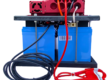
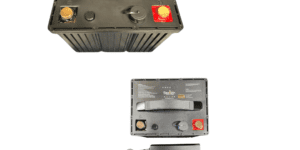
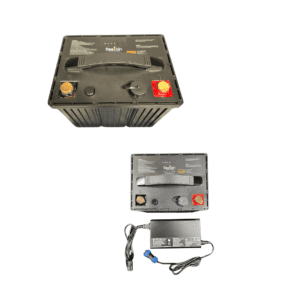
Good Sea LiON battery care means preparing differently for a dive trip and for an extended period in storage. Use the factory-matched charger for routine charging, plan an appropriate AC supply aboard the boat, and prepare a stored pack at the recommended charge level instead of leaving it fully charged for months.
This guide covers Sea LiON 50Ah and 70Ah lithium-ion batteries. Keep the instructions for your exact battery and charger with the system, and check with Brownie’s if you have an older pack, a replacement battery or a different charger.
Use the factory charger for routine charging
The practical starting point is the standard Sea LiON AC charger supplied for the battery. It provides the battery’s matched charging behavior. A boat’s nominal 12V or 24V supply is not a substitute for that charger, and a connector that fits does not establish electrical compatibility.
Identify the pack and charger before charging. Follow the supplied instructions for connection order, indicator lights, operating conditions and completion. If the instructions are missing or the charger has been changed, contact Brownie’s with photographs of the equipment labels before selecting a replacement.
Charging aboard a boat: inverter plus factory charger
For a boat with a 12V house battery bank, we recommend using a 12V-to-120V pure sine wave inverter to power the standard Sea LiON AC charger. The inverter supplies AC power, while the factory charger controls how the battery is charged.
A 600W continuous-rated pure sine wave inverter is a starting point for powering the standard charger. An 800–1,000W model provides additional capacity if you also plan to power other equipment. Before choosing an inverter, have Brownie’s and your marine installer confirm your charger’s actual input requirements and the vessel’s installation needs. Check the inverter’s continuous rating, not just its advertised peak rating.
An inverter adds conversion losses compared with direct DC charging. The benefit is retaining the factory-matched charger rather than relying on an unverified DC-to-DC setup. A boat with a different house-bank voltage needs an inverter and installation appropriate to that bank; do not assume the 12V example applies unchanged.
Why a generic DC-to-DC charger is not an automatic substitute
The Sea LiON battery uses a seven-cell-series lithium-ion configuration. Its charging requirements include 29.4V constant-current/constant-voltage charging, no more than 10A, and automatic termination when current drops below 2A during the constant-voltage stage.
Correct output voltage alone is not enough: the charger also needs appropriate current control and automatic termination. The battery’s hardware-based battery management system does not replace the charger’s normal termination function. Have Brownie’s approve the complete charger and battery combination before considering an alternative to the factory charger.
For onboard charging, the inverter-and-factory-charger approach keeps the matched charger in control. If you want a direct DC-to-DC solution, ask Brownie’s about approved options for your exact battery before buying or installing one.
Prepare extended storage at about 60% charge
To prepare your Sea LiON battery for extended storage:
Fully charge the pack using its charger.
Then discharge approximately 40% of its capacity.
Leave approximately 60% charge remaining for storage.
Discharge 40% means leave about 60%, not leave 40%. Complete the full-charge step before reducing the charge for storage; simply topping the battery up to 50% is a different procedure. Avoid leaving the pack fully charged for extended periods, as this may affect its lifespan.
This preparation is for extended storage, not a routine to repeat before every dive. Do not fully discharge the battery or deliberately run it down while divers depend on the air supply. Ask Brownie’s for the approved method of reaching the storage level for your pack; do not improvise a discharge load or use the charging connector as a general-purpose power outlet.
For storage temperature and check intervals, follow your pack’s current instructions or ask Brownie’s. A generic lithium-battery schedule may not apply to your exact pack.
Separate trip readiness from storage preparation
Check condition and resolve changes before the trip
Allow time to report visible casing or cable damage, changed connectors, signs of moisture, abnormal charging behavior or an unexpected reduction in performance. Give Brownie’s the model information, battery and charger labels, approximate age, service history and a description of what changed.
Normal charging and discharging are useful signs of operation, but they are not a complete safety test or a guarantee of battery health. Follow the inspection and service instructions for your equipment. Do not open a pack, probe connector pins or attempt an improvised electrical repair.
Keep the current manuals and Sea LiON product information with your trip records. When carrying a spare, account for its matching charger and protective case as well as the battery itself.
Frequently asked questions
Should I leave a Sea LiON battery fully charged for long-term storage?
For extended storage, fully charge the battery first, then discharge about 40%, leaving roughly 60%. Keeping it fully charged for too long may affect lifespan. Confirm the approved preparation method for your exact pack with Brownie’s.
Can I charge it from my boat without a dedicated DC-to-DC charger?
Yes. Use a suitable pure sine wave inverter to power the standard Sea LiON AC charger. Have the actual charger requirements and boat installation checked before selecting the inverter.
Is any 29.4V charger compatible?
No. A compatible charger also needs the correct current control and automatic charge termination. Have Brownie’s approve the complete charger and battery combination; matching voltage alone does not establish compatibility.
Does good battery maintenance determine safe dive time?
No. Charge readiness is one part of preparation. Runtime and capability depend on the configuration, divers and conditions. Follow current training and operating limits, and remain prepared for a loss of the surface air supply.
Brownie’s free training course is available to everyone. Brownie’s also recommends Spare Air and a dive computer for each diver, especially beyond 30 feet; these are available together as the Safety Bundle. Battery care and supplemental equipment do not replace training or dive planning.